From The Workbench
A hands-on account of making, experimenting, and learning as we go.
Choosing Your First Fountain Pen for Sketching: A Workbench Test
My interest in fountain pens began with a line.
It was not a particularly impressive line—just a loose curve running along the edge of a coffee cup in my sketchbook. But it felt different from the lines I usually made with a disposable fineliner.
The fountain pen seemed to glide rather than drag across the paper. The ink flowed continuously, responding to the speed of my hand. The resulting line was dark and immediate, but not mechanically perfect. It had a little personality.
I drew another line.
Then another.
I could get used to this.
Until that moment, I had thought of fountain pens primarily as writing instruments—handsome, old-fashioned tools used for letters, journals, and important signatures. I had not seriously considered choosing a fountain pen for sketching.
Now I understood the appeal.
A fountain pen could be refilled, carried almost anywhere, and used to make everything from careful architectural lines to quick, energetic gestures. It also suited the kind of artist I imagined becoming: someone with a sketchbook in one hand and a dependable pen in the other, ready to draw whenever an interesting subject appeared.
There was just one question:
How do I choose my first fountain pen for sketching?
What Makes a Fountain Pen Good for Sketching?
I began by thinking about what I actually needed from a sketching pen.
Not the most expensive fountain pen or the most impressive one on my workbench. I wanted a practical drawing tool—something comfortable enough for longer sketching sessions but portable enough to take on trains, into coffee shops, and along neighborhood walks.
My first fountain pen for drawing needed to:
- Feel comfortable in my hand
- Start reliably without excessive scribbling
- Produce a line suitable for my drawing style
- Move smoothly across different sketchbook papers
- Work with bottled waterproof ink
- Be easy enough for a beginner to fill and clean
- Fit inside my portable urban sketching kit
- Be affordable enough that I would actually take it outside
That last point mattered more than I expected.
A beautiful pen does me little good if I am afraid to carry it. Once this becomes more of a regular habit I might consider other choice options when I choose a fountain pen for sketching.
Laying the Fountain Pens on the Workbench
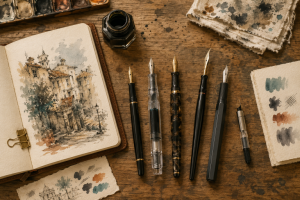
Tough choice picking just one fountain pen for sketching.
I cleared a space on my workbench and placed several fountain pens beside my sketchbook.
There was a lightweight Pilot 78G, a transparent TWSBI ECO, a Jinhao C-Flex, a Sailor fountain pen with a curved fude nib, and a fountain pen with a specialty nib.
Some were slim and light. Others had wider barrels and noticeably more weight. Some produced very fine, controlled lines, while others promised broader, more expressive marks.
Naturally, I wanted all of them.
You are choosing your first sketching pen, I reminded myself. You are not opening a fountain-pen museum.
Beside the pens, I arranged a bottle of ink, a converter, a cup of clean water, a folded cloth, and several types of paper. I included smooth drawing paper, a watercolor sketchbook, and an inexpensive pad with a slightly rougher surface.
A pen might feel wonderful on one paper and entirely different on another. If I planned to use watercolor paper regularly, I needed to test it there rather than relying only on smooth writing paper.
At the top of a blank page, I wrote:
Fountain Pen Test
Then the auditions began.
Choosing a Fountain-Pen Nib for Drawing
The nib is the metal point that touches the paper and delivers the ink. Its width has a significant effect on the appearance and character of a sketch.
Fine and extra-fine nibs create thinner lines, making them useful for small drawings, crosshatching, facial details, and architectural subjects. Medium nibs produce darker, more visible lines with a fuller flow of ink. Broad and specialty nibs can make expressive marks but may overwhelm small drawings or tightly packed sketchbook pages.
The TWSBI ECO nib guide offered a simple starting point. TWSBI recommends an extra-fine nib for small writing, fine as a popular general-purpose choice, medium for larger marks, and broad for bold statements and shading. The ECO is also available with a 1.1 mm stub nib for italic-style line variation.
Writing and sketching are not exactly the same, but the guide helped me understand what each nib might bring to a drawing.
Extra-fine for tiny details. Fine for everyday sketching. Medium for stronger lines. Broad when I want the ink to take over.
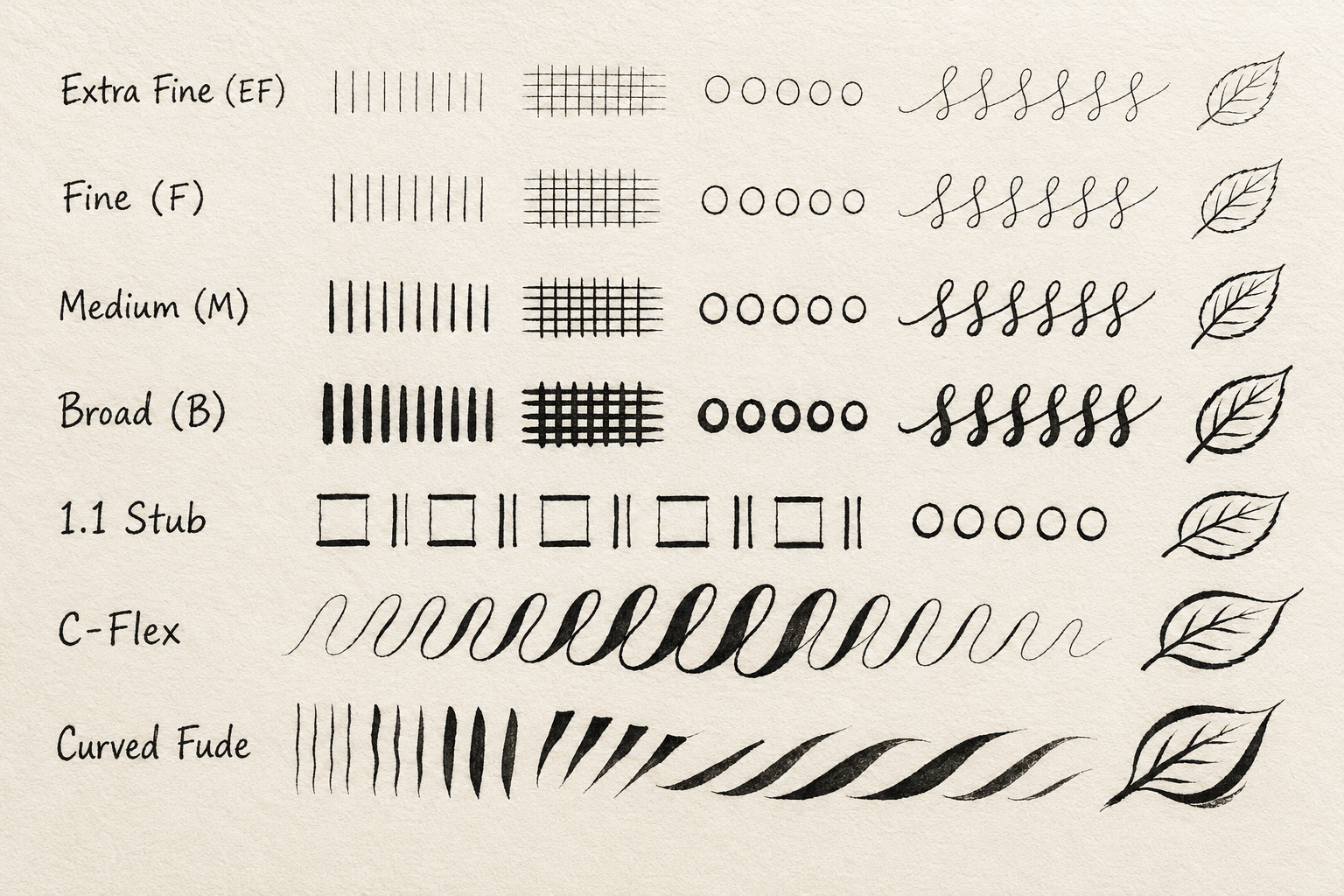
Different Nibs Make Different Line Weights
I began with a fine nib.
I drew a row of small boxes, circles, spirals, and overlapping lines. Then I sketched the ink bottle sitting in front of me. The fine point made it easy to draw the bottle’s narrow rim and the small reflections in the glass.
Precise. Controlled. Very tidy.
Perhaps a little too tidy.
Next, I tried a medium nib. The line was darker and more assertive. It filled shadowed areas quickly and gave simple contours more presence, but some of the smaller details in my drawing began merging.
Good for bold sketches. Maybe too broad for the little sketchbook I carry.
The broad nib made an even stronger mark. It was useful for deep shadows, silhouettes, and areas that needed to be filled quickly. However, it left very little room for delicate details.
The stub nib was different again. Its flat writing edge created narrow lines in one direction and wider strokes in another. Even simple boxes and rooftops gained noticeable line variation.
It was wonderfully expressive.
It was also obvious that I would need practice.
One moment I was drawing a delicate window frame. The next, a slight change in the pen’s angle produced a line wide enough to fill the entire window.
Interesting—but perhaps not the easiest place to begin.
A flexible nib presented another possibility. A pen such as the Jinhao 9016/82 C-Flex Fountain Pen can appeal to artists who want more expressive line variation. Changes in pressure and movement can help make outlines feel more energetic and organic.
I drew a leaf using very little pressure, then pressed slightly harder as I moved into the stem. The changing line gave the drawing a lively quality that the standard nibs did not produce.
However, controlling that variation required more attention.
This could be fun once I learn what it wants to do.
Then I tested the Sailor fountain pen with the curved fude nib. The bent nib made it possible to change the line width by adjusting the angle of the pen and the amount of the nib touching the paper. Held at a shallow angle, it produced broad, sweeping marks. Raised slightly, it made narrower lines suitable for details.
I drew a few blades of grass, a roofline, and the curved handle of a cup. The fude nib moved quickly from delicate contours to bold shadows without requiring the pressure changes of a flexible nib.
This is less about pressing harder and more about learning the right angle.
The Sailor’s curved fude nib was especially appealing for expressive sketching, foliage, figures, and subjects that benefited from varied marks. It was not as immediately predictable as the fine nib, but its range made even simple studies feel lively.
After trying each option, I kept returning to the fine nib. It suited the size of my sketchbook, left room for watercolor washes, and felt predictable without making every line feel mechanical.
For my first fountain pen for sketching, fine felt like the right place to begin. The Sailor fude nib, however, quickly became one of the most interesting alternatives for artists who want expressive line variation from changes in angle rather than pressure.
Testing the TWSBI ECO for Sketching

I could sketch for days with the amount of ink this pen holds!
The next pen on my workbench looked noticeably different.
The TWSBI ECO Fountain Pen had a transparent barrel that allowed me to see the ink inside it. I found myself tilting the pen back and forth, watching the ink move through the reservoir.
That probably has nothing to do with drawing.
Perhaps not—but I liked it anyway.
Unlike a cartridge-and-converter fountain pen, the TWSBI ECO uses an integrated piston-filling system. To fill it, I submerged the nib in bottled ink and operated the piston using the knob at the end of the barrel.
Its generous reservoir was appealing because it meant I could make many drawings before worrying about running out of ink. That could be especially useful for an artist spending an entire day urban sketching, traveling with a sketchbook, or filling large areas with crosshatching.
For the small drawings and architectural details in my sketchbook, I would choose either the extra-fine or fine nib. An artist who prefers darker, bolder sketches might choose medium or broad, while the stub nib could create more calligraphic line variation.
I tested the fine nib by drawing a row of jars and paintbrushes across the top of the page. The line was smooth and consistent, and the pen felt reassuringly substantial in my hand.
Then I filled a small rectangle with crosshatching.
The ink continued to flow without hesitation.
This one feels ready for a full day of drawing.
The TWSBI ECO had several qualities that made it attractive for sketching:
- A large built-in ink reservoir
- A transparent barrel that made the remaining ink easy to see
- Several nib sizes ranging from extra-fine to stub
- An inner cap designed to help prevent the nib from drying
- A substantial feel for artists who prefer a larger pen
- Direct filling from bottled ink without a separate converter
However, it was not quite as light and simple as the Pilot 78G. The built-in piston also meant that filling and cleaning the pen required a little more involvement than replacing a cartridge.
I placed the TWSBI beside the Pilot and looked at them both.
The Pilot feels lighter. The TWSBI carries more ink. Which matters more to me?
That was becoming the real question.
Comparing the Fountain Pens for Sketching
By this point, every pen on the workbench had revealed a different personality.
Pilot 78G
The Pilot 78G Fountain Pen was the lightest and most comfortable option in my portable sketching kit. I liked its smooth ink flow and the way it almost disappeared in my hand while I drew.
Best for: Artists wanting a lightweight, straightforward first sketching pen.
TWSBI ECO
The TWSBI ECO held more ink in its piston-filled reservoir and allowed me to see how much remained. It felt more substantial and seemed particularly well suited to longer sketching sessions and travel.
Best for: Artists wanting a larger ink supply, visible ink level, and a wide selection of nib sizes.
Jinhao C-Flex
The Jinhao 9016/82 C-Flex Fountain Pen offered more expressive line possibilities. It appealed to me when I wanted outlines that varied in character rather than remaining perfectly consistent.
Best for: Artists interested in expressive lines and experimenting with pressure.
Sailor Fountain Pen With Curved Fude Nib
The Sailor fountain pen with the curved fude nib offered a different kind of flexibility. By changing the angle of the pen, I could move from fine details to broad, painterly strokes. It was particularly effective for foliage, figures, architectural contours, and quick gestural sketches.
Best for: Artists who want dramatic line variation controlled through nib angle rather than pressure.
Stub-Nib Fountain Pen
The stub nib produced thin or broad strokes depending on the direction in which I moved the pen. It was the most calligraphic—and initially the most unpredictable—option on the workbench.
Best for: Artists who want noticeable line variation and are willing to practice controlling the nib’s angle and direction.
Does Pen Weight Matter for Sketching?
Next, I paid closer attention to how each fountain pen felt in my hand.
A heavier pen can feel substantial and beautifully balanced. For short writing sessions, that weight may even feel reassuring. But drawing often involves continuous movement—circles, hatching, long contours, and rapid changes in direction.
I sketched for five minutes with each pen without putting it down.
One pen felt wonderful for the first minute but increasingly heavy by the fifth. Another was so narrow that I found myself gripping it too tightly. A third had a comfortable barrel but became awkward when I placed the cap on its back.
Stop admiring the pen and pay attention to your hand.
That was good advice.
The best fountain pen for sketching should almost disappear while I use it. I should be thinking about the subject, not constantly adjusting my fingers or noticing the weight of the pen.
The Pilot 78G felt light and comfortable in my hand. More importantly, I liked the sensation of its nib moving across the paper. The ink seemed to follow my gestures without requiring me to press down.
The TWSBI ECO had a larger, more substantial presence. It did not disappear in my hand in quite the same way, but it felt solid and dependable. I also liked knowing that its larger reservoir was unlikely to run dry in the middle of a long drawing session but that extra ink was extra weight.
The Sailor fude pen required a slightly different kind of attention. Its weight mattered less than its angle. When I relaxed my grip and allowed the curved nib to move across the paper, it produced broad, confident marks. When I rotated it toward a more upright position, the line narrowed.
I drew several loose ellipses with each pen.
Then I added a few quick figures, a row of rooftops, and the tangled leaves of the plant beside my window.
Neither pen made my drawings instantly better. All three made me want to continue drawing.
That seemed like the most important quality.
Testing Fountain Pens on Sketchbook Paper
I moved from the smooth paper to my watercolor sketchbook.
The difference was immediate.
The textured surface gave each nib a little more resistance. Some lines became slightly rougher and occasionally skipped across the deepest indentations in the paper.
At first, I thought that was a problem.
Then I looked more closely.
The broken lines had character. They looked less like technical illustrations and more like something drawn by hand. When I added a few crosshatched shadows, the texture of the paper became part of each sketch.
The Sailor’s curved fude nib responded especially clearly to the paper’s texture. Broad strokes picked up the grain, while narrower marks moved more cleanly across the surface. The result was less uniform than the Pilot’s fine nib but more painterly.
Still, I did not want a pen that caught or scratched unpleasantly. I tested several lines at my normal drawing angle, moving each pen toward and away from my hand. I tried slow contours, fast gestures, dots, hatching, and a few written notes.
This is why choosing a fountain pen for sketching is so personal. The same nib can feel different depending on the paper, ink, drawing angle, and lightness of the artist’s touch.
There is no perfect pen for every artist. There is only the pen that makes sense in your hand.
Choosing Waterproof Fountain-Pen Ink
The pen was only half of the decision. I also needed ink.
For ordinary writing or monochrome ink sketches, many fountain-pen inks can work beautifully. But I wanted to add watercolor washes over my drawings. That meant the dried ink needed to resist water.
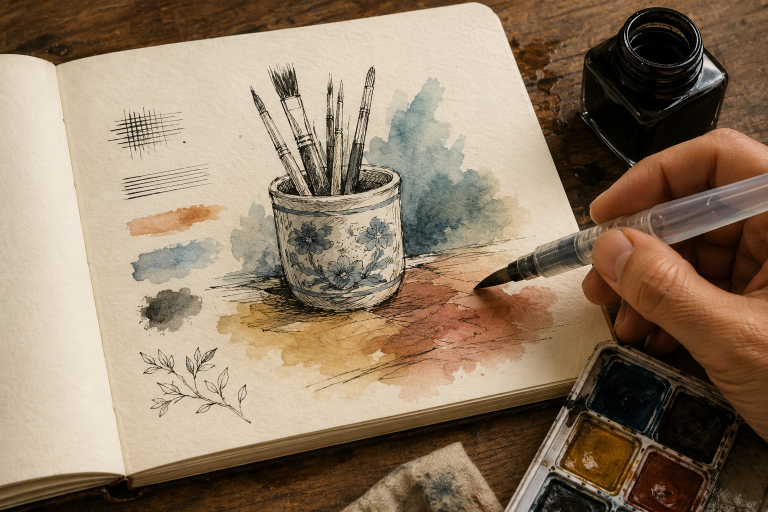
This quick watercolor wash over the waterproof ink really brings this sketch to life.
I filled the Pilot with Ostrich Vintage Waterproof Fountain Pen Ink. I drew a row of lines, wrote a few words beneath them, and added a small sketch of the ceramic cup holding my brushes.
Then I waited.
Waiting may be the least romantic part of ink-and-watercolor sketching, but it matters. Even waterproof ink needs an opportunity to dry before a wet brush moves across it.
Is that long enough?
Probably not.
I waited a little longer.
Using a Water Brush Pen, I brushed clean water across the test lines. Then I added pale ochre, blue, and burnt sienna watercolor washes over the drawing.
The black lines remained in place instead of dissolving into muddy gray streaks.
That was exactly what I wanted.
Waterproof fountain-pen ink gave me the freedom to draw first and paint afterward. I could establish the structure of a subject with ink, allow the lines to dry, and then add quick transparent washes without fearing that the entire sketch would bleed.
My First Fountain-Pen Sketch
With the testing finished, I looked around the workbench for a subject.
The obvious choice was the collection of pens and ink bottles in front of me, but my eyes settled on an old wooden hand plane sitting on a nearby shelf. Its handle was worn smooth, its metal blade was dark with age, and several scratches ran along its wooden body.
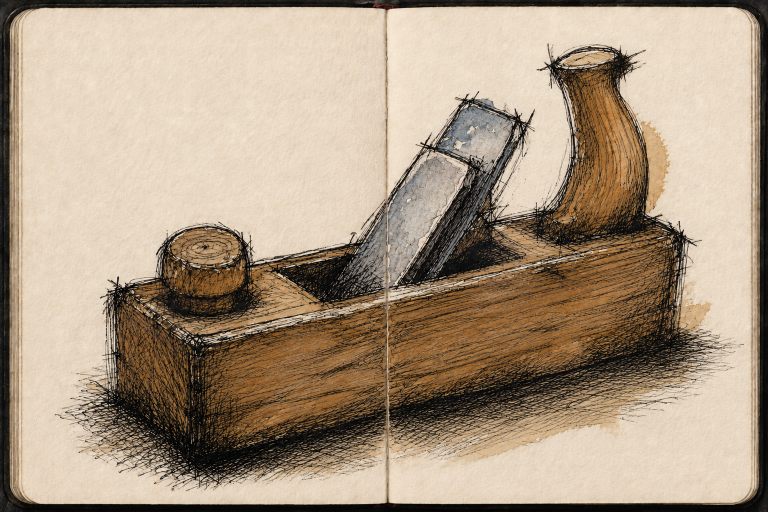
One of these days I will get back to making furniture with this old beauty.
It felt like an appropriate subject—an old tool drawn with another tool that carried an old-world spirit.
I placed the hand plane on the workbench and opened my 100% Cotton Mini Watercolor Paper Journal.
For once, I skipped the preliminary pencil drawing.
You chose the pen. Trust it.
I began with the top edge of the plane. The line leaned slightly downward when it should have been level.
There was no erasing it.
I adjusted the next line to meet it and continued.
The wooden body grew a little longer than the actual tool. The handle tilted at an uncertain angle. I redrew one side, leaving the original line visible beneath the correction.
Instead of ruining the sketch, those changes seemed to give it movement.
I added scratches to the wood, small marks around the blade, and darker hatching beneath the handle. The fine nib allowed me to build shadows gradually without filling them in too quickly.
When the ink had dried, I used the water brush to add a warm brown wash over the wood and a cool gray-blue wash across the metal.
The drawing was imperfect.
But the lines felt like mine.
Cleaning a Fountain Pen Used for Sketching
When I finished, I wiped the nib and returned the cap securely.
A fountain pen is reusable, but it needs more care than a disposable drawing pen—particularly when used with waterproof or pigment-based inks. These inks should not be allowed to dry inside the nib and feed.
I plan to use the pen regularly, keep it capped when it is not in my hand, and clean it before long periods of storage or when changing inks.
Cleaning requirements vary by ink, so it is important to follow the ink manufacturer’s instructions. For suitable pens and inks, a product such as Fountain Pen Cleaning Solution can be useful when ordinary flushing does not remove dried or stubborn residue. Always check that a cleaner is compatible with the particular pen and ink first.
If you want the pen to take care of your drawings, you have to take care of the pen.
Which Fountain Pen Did I Choose for Sketching?
After covering several pages with lines, circles, shadows, tiny buildings, and badly proportioned ink bottles, my final decision came down to the Pilot 78G, the TWSBI ECO, and the Sailor fountain pen with the curved fude nib.
The TWSBI’s large ink reservoir was tempting. I liked being able to see the ink inside the clear barrel, and I could imagine taking it on an entire day of sketching without wondering whether a converter was nearly empty.
The Sailor fude pen was the most expressive of the group. Its curved nib made it easy to shift from narrow details to broad marks simply by changing the angle. For loose urban sketches, foliage, and energetic studies, it offered a range that the fine nib could not match.
The Pilot 78G, however, felt lighter and more natural in my hand. For quick sketches, a compact kit, and long periods of loose drawing, I preferred its simplicity.
I chose the Pilot 78G as my first fountain pen for sketching—but only by a narrow margin.
If I expected to make many drawings in one outing, use heavy crosshatching, or travel without carrying an ink bottle, I might choose the TWSBI ECO instead. If I wanted the most dramatic line variation and was willing to practice controlling the nib angle, I would choose the Sailor fountain pen with the curved fude nib.
Another artist might make a completely different choice.
Someone who draws boldly may prefer a medium or broad nib. An artist who wants pressure-sensitive marks might enjoy a flexible nib. Someone interested in calligraphic line variation may prefer a stub nib. An artist who wants angle-controlled variation may prefer the Sailor fude nib. An artist who makes small, detailed drawings might choose an extra-fine nib.
That was the most useful lesson of the entire test: there was no universal winner.
- Choose the Pilot 78G for lightweight comfort and simplicity.
- Choose the TWSBI ECO for ink capacity and longer drawing sessions.
- Choose the Jinhao C-Flex for expressive, pressure-sensitive marks.
- Choose the Sailor fountain pen with the curved fude nib for broad-to-fine line variation controlled by nib angle.
- Choose a stub nib for calligraphic line variation.
Choosing your first fountain pen for sketching is not about finding the single pen every artist is supposed to own. It is about finding a pen that encourages you to open your sketchbook.
Test the nib on the paper you actually use. Notice the pen’s weight after several minutes, not just when you first pick it up. Decide whether you want precise lines, bold marks, pressure-sensitive variation, or angle-controlled fude strokes. If you plan to paint over your sketches, pair the pen with a compatible waterproof ink.
Then stop testing.
Choose a subject.
Make the first line.
Because the best fountain pen for sketching is not the one that remains perfectly clean on your workbench. It is the one that slowly becomes familiar—its barrel marked by your fingers, its nib shaped by your habits, and its ink scattered across page after page of things you took the time to notice.
Fountain-Pen Sketching Supplies From This Project
- Pilot 78G Fountain Pen — a lightweight fountain pen chosen for its comfortable feel and smooth ink flow.
- TWSBI ECO Fountain Pen — a piston-filling pen with a visible ink reservoir and several available nib sizes.
- Jinhao 9016/82 C-Flex Fountain Pen — an option for artists interested in more expressive line variation.
- Sailor fountain pen with curved fude nib — a specialty fountain pen for angle-controlled line variation and expressive sketching.
- Ostrich Vintage Waterproof Fountain Pen Ink — waterproof ink suitable for adding watercolor washes over dry pen lines.
- Water Brush Pen Set — portable brushes with water stored inside their handles.
- 100% Cotton Mini Watercolor Paper Journal — a compact surface for ink-and-watercolor sketching.
- Fountain Pen Cleaning Solution — for compatible pens and inks requiring more thorough cleaning.



0 Comments