
From The Workbench
A hands-on account of making, experimenting, and learning as we go.
Sketch Journaling on Vacation: A Powerful Way to Capture Memories Photos Can’t
Sketch journaling on vacation began for me with a slightly uncomfortable realization: I could barely remember the details of my last trip.
I remembered where I had gone. I remembered the hotel, the broad outline of the journey, and the landmarks I had visited. My phone held hundreds of photographs to prove it.
But when I scrolled through them, one image blended into the next. There were buildings I did not remember stopping to admire, meals I could no longer taste, and scenic views that looked strangely detached from the experience of standing in front of them.
The photographs showed what the trip looked like.
Very few of them reminded me what it felt like.
So, before my next vacation, I placed a small sketchbook on my workbench and made a decision.
This time, I want to bring home more than pictures.
Why Keep a Vacation Sketch Journal?
A vacation sketch journal is part sketchbook, part diary, and part handmade collection of memories. It can contain drawings, watercolor washes, written observations, dates, maps, tickets, receipts, labels, pressed leaves, and anything else that helps tell the story of a trip.
It does not need to be a polished travel album. In fact, I suspected mine would be better if it was not.
Phone cameras make it easy to capture hundreds of images without really looking. I can lift my phone, tap the screen, and move on in seconds. The photograph joins a crowded memory bank filled with other photographs, screenshots, accidental duplicates, and images I meant to organize but never did.
A sketchbook asks for something different.
It asks me to stop.
To draw a doorway, I have to notice the curve of the arch. Painting the color of the sea, I have to decide whether it is blue, green, gray, or somehow all three. To record a café breakfast, I have to notice the chipped edge of the plate, the folded paper napkin, and the shadow beneath the coffee cup.
That attention changes the memory.
The finished drawing may be crooked, incomplete, or smeared by a hurried watercolor wash. But it carries the evidence of the moment I spent making it.
Packing a Simple Travel Sketching Kit
Before the trip, I laid everything I might possibly need across the workbench.
There were several sketchbooks, multiple pencils, three fountain pens, bottles of ink, colored pencils, watercolor tubes, brushes, palettes, erasers, sharpeners, clips, tape, scissors, glue, and a small cloth.
It was an excellent collection of supplies.
It was also far too much to carry on vacation.
You are packing a sketching kit, not relocating the workbench.
I began removing things.
My final vacation sketch journaling kit included:
- A compact 100% Cotton Mini Watercolor Paper Journal
- A Twsbi Eco Fountain Pen
- Ostrich Vintage Waterproof Fountain Pen Ink
- One pencil and a small eraser
- A Portable Watercolor Travel Set
- A Water Brush Pen
- A small cloth
- A few clips and short pieces of tape
- A glue stick for adding paper keepsakes later
Everything fit into a small pouch.
The compact kit mattered. If my supplies were awkward to unpack, I knew I would leave them in the hotel room. I wanted to be able to open the journal and begin drawing in less time than it took to convince myself I was too busy.
Beginning the Journal Before the Vacation

Packing the bare essentials.
I did not wait until I reached my destination to make the first page.
The night before leaving, I drew the suitcase sitting beside my workbench. It was not an especially romantic subject. One corner bulged because I had packed too much, and a luggage tag hung at an awkward angle.
That was exactly why I drew it.
The trip had already begun.
Beside the sketch, I wrote the date, my destination, and a short list of things I hoped to notice:
- The color of the morning light
- Something people said
- A meal I would want to remember
- A building with character
- One quiet moment
The list gave the journal a purpose. I was not trying to document every hour. I was preparing myself to pay attention.
My First Vacation Sketch
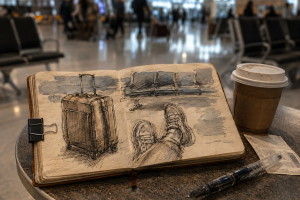
Time to kill…Sketch.
My first sketch during the trip was made while waiting to leave.
Rows of seats stretched across the terminal. Bags rested against ankles. Travelers looked at watches, guarded paper cups of coffee, and stared toward a departure board as though concentration alone might make it change.
I considered drawing the entire scene.
Then I looked at my small page.
Perhaps start with one suitcase.
I drew the suitcase across from me, then added the shoes of its owner and the edge of a chair. The person moved before I finished, leaving one shoe with an uncertain outline and no convincing connection to the leg above it.
I wrote the departure time beside the drawing and added a gray-blue wash behind the chairs.
It was not a complete picture of the terminal.
It was enough to bring back the waiting.
Sketching the First View
When I arrived, I was tempted to begin with the largest view available—the rooftops, the water, the distant hills, and the entire sweep of the unfamiliar place.
My sketchbook was small. My ambition was not.
I stood near the window of the room and tried to fit everything onto one page. The buildings became cramped. The horizon tilted. A balcony railing collided with a roof that should have been much farther away.
This is becoming less of a view and more of a structural disagreement.
I stopped trying to capture everything.
On the next page, I drew only the nearest rooftop, one chimney, and a crooked television antenna. I added a pale wash for the sky and allowed the color to run loosely beyond the ink lines.
The smaller subject said more.
It reminded me where I stood, what I saw first, and how the late-afternoon light warmed the roof tiles. That page became the true beginning of the vacation journal.
Capturing the Small Moments That Photographs Miss
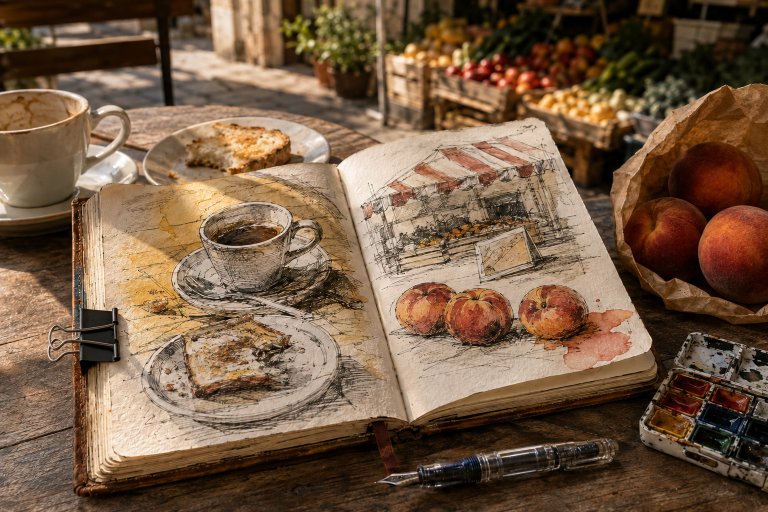
A lazy breakfast. I can still remember the sweet taste of those peaches.
The most meaningful pages were rarely devoted to the famous sights.
One morning, I sketched breakfast at a small café. The coffee arrived first, so I drew the cup while waiting for the food. When the plate came, I added part of it beside the cup. By the time I reached the toast, I had already eaten one corner.
I drew the missing piece anyway.
Beside the sketch, I wrote the name of the café, the weather, and a sentence spoken by someone at the next table. I added a small blot of warm yellow watercolor where sunlight crossed the tabletop.
On another page, I drew a market vendor’s striped awning, three peaches, and a handwritten price sign. The market was too crowded to sit and make a careful drawing, so I worked quickly. Some lines doubled back over themselves. The lettering leaned downhill. A red wash escaped the boundary of one peach and spread into the margin.
I nearly corrected it later.
I am glad I did not.
The wandering color makes me remember the hurried energy of the market better than a tidy painting would.
Adding Words, Sounds, and Sensory Memories
A sketch journal does not have to rely on drawings alone.
When I could not stop long enough to sketch, I wrote fragments:
Church bells at eight.
Warm bread through an open bakery door.
Wind strong enough to turn the umbrella inside out.
Blue shutters. Green bicycle. Yellow dog asleep in the shade.
These small notes became prompts for later sketches, but many were complete memories by themselves.
I also wrote down colors I wanted to remember, short pieces of conversation, the names of unfamiliar foods, and questions I planned to look up later. A few words could preserve the sound, temperature, smell, or mood of a place—things a photograph could not reliably hold.
The journal gradually became less like a collection of finished pictures and more like a conversation with the trip.
Saving Tickets, Receipts, and Travel Ephemera
By the third day, folded pieces of paper had begun accumulating in my pockets.
There was a transit ticket, a small museum receipt, the paper band from a bakery box, and a café napkin stamped with a simple logo.
Normally, I would have carried these items home with good intentions, placed them in a drawer, and forgotten why I had saved them.
Instead, I added selected pieces directly to the journal.
The transit ticket became part of a page about the journey into town. I placed the bakery label beside a quick ink drawing of the pastry it had wrapped. A narrow piece of Retro Stamp Washi Tape held one lightweight paper keepsake in place while adding to the old-world travel-journal character of the page.
I did not attach everything. A sketchbook can become bulky surprisingly quickly, and thick objects may damage its binding. I chose flat, lightweight pieces and left room around them for notes and drawings.
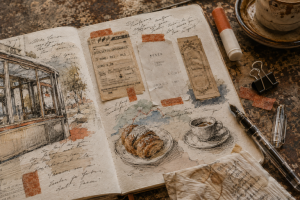
Trash or Memories?
The pieces of paper were ordinary.
Together with the sketches, they became evidence of a day I could hold in my hands.
When a Vacation Sketch Goes Wrong
Not every page worked.
I tried to draw a narrow street lined with balconies and hanging plants. Halfway through, I realized I had made the nearest building so wide that there was barely room for the street.
I squeezed the remaining buildings into the available space.
The result was architecturally doubtful.

I remember that street being wider.
Then I added watercolor before the ink was completely dry. A dark line beneath one balcony bled into the wall, creating a gray shape that looked suspiciously like smoke damage.
My first impulse was to remove the page.
No one has to know this happened.
But a vacation sketch journal is not a portfolio. It is a record of looking, making, and being present. The failed perspective and bleeding ink belonged to that afternoon as much as the successful drawings did.
I wrote a note beneath it:
The street was much wider than this.
That sentence changed the page. Instead of looking like an unsuccessful illustration, it became an honest travel memory with a little humor in it.
Sketch Journaling on Vacation Without Missing the Vacation
I did not want sketch journaling on vacation to become another demanding itinerary.
There were days when I wanted to explore rather than sit with my supplies. There were meals I wanted to eat while they were hot and views I wanted to enjoy without immediately turning them into a project.
So I stopped expecting a finished page every day.
Some days, I made one ten-minute sketch. On others, I wrote three sentences and taped in a ticket. Sometimes I made a quick pencil outline on location and added watercolor later. If the moment was moving too quickly, I took a reference photograph and returned to the page that evening.
The journal was there to deepen the vacation, not compete with it.
A simple routine helped:
- Add the date and location.
- Choose one small subject.
- Draw for five to fifteen minutes.
- Add one or two colors.
- Write one detail a photograph might miss.
That was enough.
Why a Sketchbook Can Hold More Feeling Than a Phone
I still took photographs during the trip. Some moments happen too quickly to draw, and photographs can preserve faces, places, and details with remarkable accuracy.
But I noticed a difference when I looked through them later.
The photographs showed everything with equal certainty. Every roof tile, cloud, chair, and passing stranger had been captured instantly. Yet because the camera had made all the decisions for me, many images felt oddly distant.
The sketchbook was selective.
It contained the coffee cup I chose to notice, the roofline I struggled to understand, and the peaches I drew while people moved around me. It held the sentence I overheard, the paint mixed too wet, the ticket folded into my pocket, and the mark left by a hurried hand.
Hundreds of technically accurate photographs can languish unseen in a phone’s memory bank. A sketch journal is smaller, slower, and incomplete—but that incompleteness is part of its power.
Every page answers a personal question:
What mattered enough for me to stop and notice?
Returning Home With a Handmade Record
After the vacation, I placed the journal back on my workbench.
It had changed.
The cover was slightly worn. Several pages had buckled from watercolor. A corner of the transit ticket lifted when I turned the page. There was a faint coffee stain beside the café sketch and a grain of sand trapped near the binding.
None of those things made the journal look polished.
They made it feel traveled.
When I opened it, the memories returned differently than they did when I scrolled through my phone. I remembered the pause before drawing the first line. The memory of mixing a color while the wind dried it too quickly. I remembered where I sat, what I heard, and why I chose that particular subject.
The sketchbook did not contain the whole vacation.
It contained my vacation.
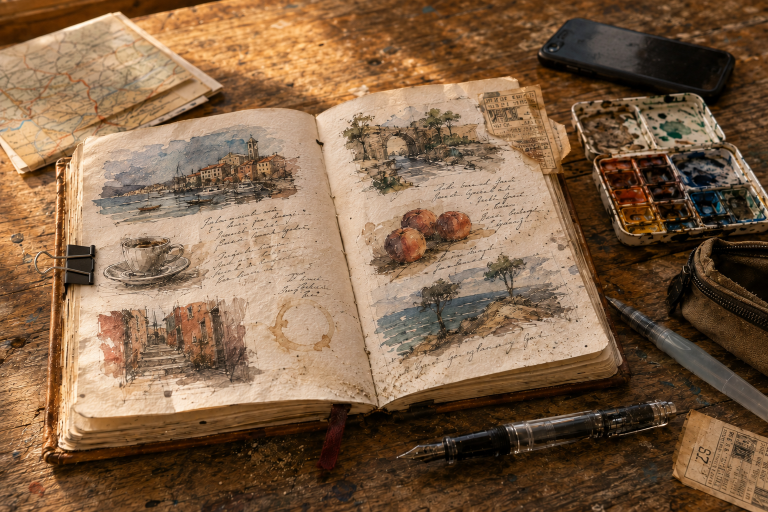
Each drawing brings me right back to that moment.
Simple Tips for Starting a Vacation Sketch Journal
- Pack lightly. A compact kit is more likely to leave the hotel room with you.
- Begin before departure. Draw your suitcase, travel documents, or the first cup of coffee on the journey.
- Choose small subjects. A doorway, meal, shoe, sign, window, or single tree can hold an entire memory.
- Add words. Record weather, sounds, tastes, overheard phrases, and how the moment felt.
- Use waterproof ink when adding watercolor. Give the ink time to dry before brushing water across it.
- Let watercolor overrun the lines. Loose washes can make a page feel energetic and immediate.
- Save lightweight paper keepsakes. Tickets, labels, and receipts can add place and texture without making the book too bulky.
- Do not tear out imperfect pages. Mistakes often become the most personal parts of the journal.
- Set a small goal. Ten attentive minutes can preserve more feeling than dozens of hurried photographs.
- Allow yourself to enjoy the trip. The journal should support the experience, not control it.
The Memory Is in the Making
Sketch journaling on vacation did not stop me from taking pictures. It changed the way I looked before I took them.
I began noticing the details between the landmarks—the half-finished drink, the handwriting on a market sign, the afternoon shadow crossing a wall, and the view from a temporary window.
Those details might not have earned a permanent place in my phone’s crowded memory bank.
They earned a place in my sketchbook.
A travel journal does not need perfect drawings, sophisticated lettering, or beautifully arranged pages. It needs curiosity, a few simple tools, and the willingness to pause.
Open the book.
Write the date.
Draw one thing.
Years from now, the crooked lines and uneven washes may carry you back more vividly than the hundreds of photographs you forgot to look at.
Because a photograph records a fraction of a second.
A sketch remembers the time you gave it.
Vacation Sketch-Journaling Supplies From This Project
- 100% Cotton Mini Watercolor Paper Journal — a compact journal for ink sketches, watercolor washes, written notes, and lightweight paper keepsakes.
- Portable Watercolor Travel Set — portable colors for adding quick washes while traveling.
- TWSBI Eco Fountain Pen— a large ink capacity pen for travel sketches and written observations.
- Ostrich Vintage Waterproof Fountain Pen Ink — waterproof ink for lines that remain in place beneath watercolor after drying.
- Water Brush Pen Set — portable brushes that carry water inside their handles.
- Retro Stamp Washi Tape — decorative tape for adding lightweight travel ephemera and an old-world journal character.


0 Comments